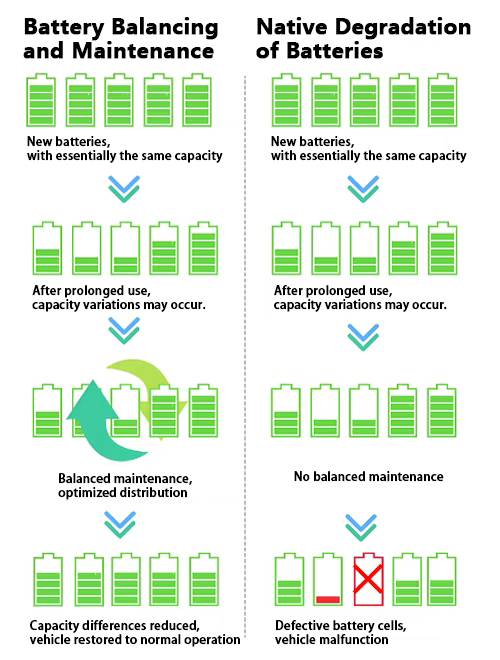
In the world of batteries, “consistency” is a critical concept. Whether it's common lithium batteries or traditional lead-acid batteries, consistency directly impacts battery performance, lifespan, and usage safety. Take lead-acid batteries as an example: when one cell fails and is replaced with a new one, achieving optimal performance often proves difficult. This is because the new cell differs in performance from the original cells, failing to achieve good consistency. A lead-acid battery may appear simple, but internally it consists of six cells, equivalent to six series connections. Lithium batteries differ: typically, a single cell functions as one series connection, or two cells are connected in parallel to form one series connection. Why is battery consistency so crucial? In everyday applications, any battery system beyond a single 3.2V or 3.7V cell requires multiple cells working in concert. Consider a 72V battery pack: it consists of 24 cells connected in series, relying on the cumulative voltage of multiple cells to function. Under such conditions, the fundamental requirement is that all cells charge simultaneously to full capacity and discharge simultaneously to complete depletion. However, the significance of consistency extends far beyond this. Each battery string must maintain consistent capacity and voltage. Voltage is further categorized into static and dynamic values: static voltage must remain stable, while dynamic voltage during charging and discharging must also be uniform. Internal resistance is equally critical—its magnitude affects both charging/discharging voltage and heat generation, with higher resistance leading to greater thermal output. Additionally, temperature characteristics, lifespan, and thermal decay after multiple charge-discharge cycles must remain consistent across all cells. After all, batteries undergo thousands of cycles and can last 8 to 10 years. Inconsistent degradation significantly compromises the entire pack's performance. So how is battery consistency achieved? First, cell quality must be top-notch. It cannot be achieved by superficially matching cells with subpar performance, as this fails to guarantee consistent lifespan and degradation. Second, cells should originate from the same manufacturer and model, with minimal production time gaps. For instance, a new 53Ah cell produced in January versus February may exhibit performance differences. Additionally, cell capacity and internal resistance must be identical.
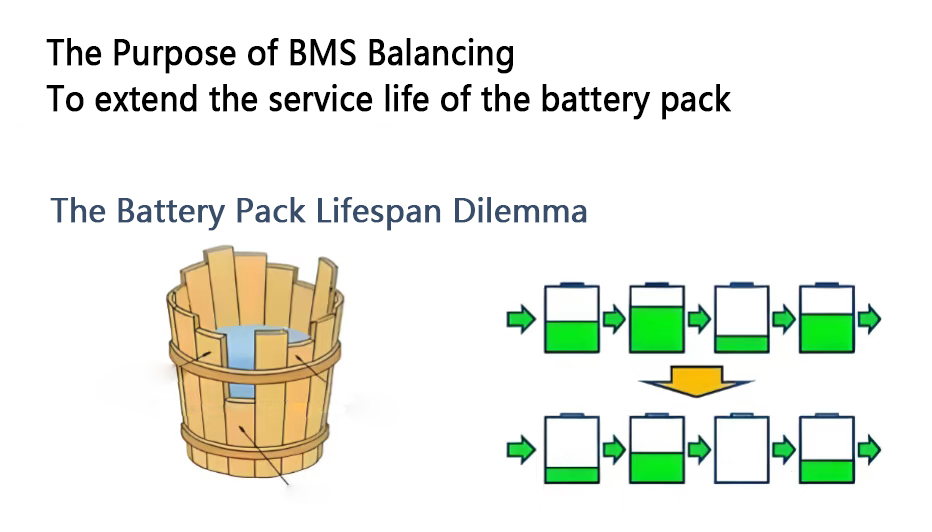
In practical applications, cells from different manufacturers should not be combined even if they share the same capacity. Mixing batteries of varying sizes or specifications in parallel is generally inadvisable. While coincidental success may occur, the probability is extremely low. For battery packs assembled by first paralleling then series-connecting cells, consistency requirements are even more stringent, as parallel connections also demand uniform cell parameters. Battery consistency is a complex and critical field. Only through deep understanding and rigorous control can efficient, stable operation of battery packs be ensured, providing reliable power support for various devices.

Copyright © 2026 Shandong Shanglai Import and Export Co., Ltd. All Rights Reserved.