We’ve been in the battery game for over a decade. Our packs have powered everything from scooters in Southeast Asia to legacy golf carts in Europe. And if there’s one thing we’ve learned, it’s this: building batteries for low-speed vehicles (LSVs) isn't about fancy specs—it's about surviving the real world.
A lot of people think a power battery is just a bunch of cells taped together and stuffed into a plastic case. Having spent years on the factory floor and at customer sites, we can tell you it’s way more complicated—and a lot more humbling—than that.
Here’s the straight talk on what it takes to build reliable power batteries for 2-wheelers, 3-wheelers, and 4-wheelers.
A few years ago, battery swap stations catching fire overseas gave everyone a wake-up call. In this industry, one bad pack can ruin your reputation overnight.
For electric motorcycles and e-bikes, our philosophy is simple: Safety margins are not optional.
In tropical climates, it’s not uncommon for ambient temperatures to hit 40°C (104°F), and battery compartments are rarely ventilated. That’s why we’ve doubled down on LiFePO4 (LFP) chemistry. Sure, it’s heavier than NMC, and it loses some capacity in the cold, but when a rider is stuck in traffic on a hot day, the priority isn't range—it's that the battery doesn't turn into a hazard.
We actually design our cases to be slightly bulkier than necessary just to ensure there’s enough airflow around the cells. It’s not the most "compact" solution, but it’s the one that comes back from the field without drama.
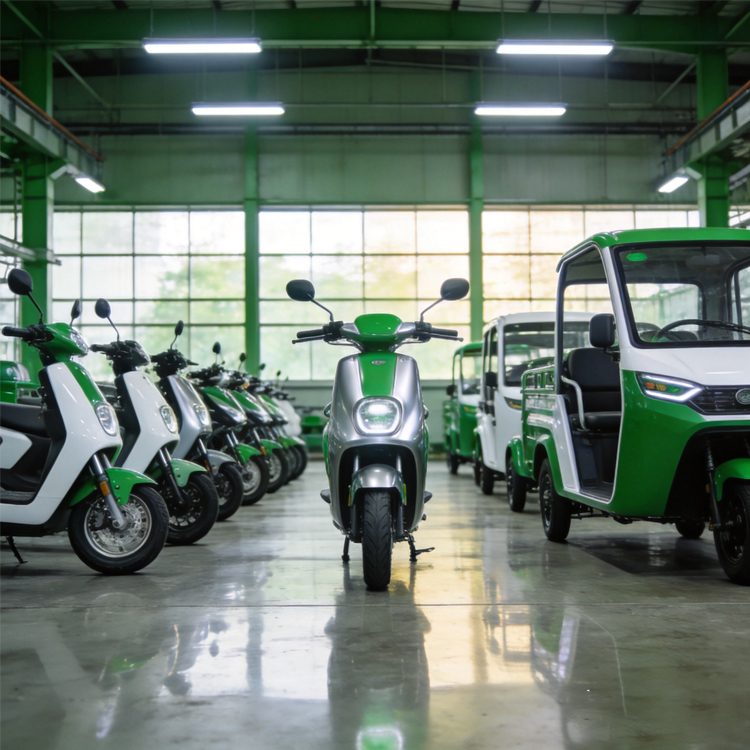
If two-wheelers are about commuting, three-wheelers are about earning a living. We’ve seen them overloaded with cargo—sometimes twice their rated capacity—climbing steep hills on terrible roads.
Here, the conversation isn't about "Capacity" (Ah); it’s about Discharge Rate (C-rate) and Vibration Resistance.
When a driver floors the throttle on a steep incline with a heavy load, the current spike is massive. If the busbars aren't thick enough or the spot welding is weak, resistance builds up, heat follows, and the pack fails.
That’s why we insist on thicker nickel strips and, in many cases, potting (encapsulation). Yes, it adds weight and cost, but it locks the cells in place against vibration and acts as a thermal buffer. It’s the "boring" part of manufacturing that prevents the "exciting" (and dangerous) failures later on.
This segment—golf carts, resort shuttles, and utility vehicles—is all about Cycle Life.
The math for a golf course operator is simple: if a battery lasts 8 years instead of 4, that’s pure profit. This is where LiFePO4 absolutely dominates. With 3,000+ cycles, you can charge it every single day for a decade and it’ll still be kicking.
But here’s the trap: Compatibility.
Many older carts still use Lead-Acid chargers. If your Lithium BMS isn't smart enough to play nice with those old voltages, you get "Charging Faults." We’ve had engineers fly out just to tune the BMS parameters so our batteries could work seamlessly with a customer’s existing infrastructure. It’s a hassle, but it’s how you win trust.
Customers always ask us: "Which is better?"
Our answer isn't a sales pitch; it’s a question back: "Where are you using it?"
NMC (Ternary Lithium): If you’re in Scandinavia, need lightweight performance, or are building high-speed e-motorcycles, NMC makes sense. Better energy density, better cold-weather performance.
LFP (LiFePO4): If you’re in India, Africa, or Southeast Asia, or if you’re building workhorses (like cargo trikes or golf carts), LFP is the only logical choice. It’s safer, cheaper in the long run, and practically bulletproof.
Raw material prices fluctuate wildly. As a factory, our job isn't to push the most expensive tech; it’s to match the right chemistry to the right job. Sometimes, saving the customer money is the best way to keep them for life.
The battery business looks like manufacturing on the surface, but underneath, it’s a trust business.
We aren’t the biggest factory out there. But every time we load a container onto a ship, the goal is the same: No headaches for the client. No black eyes for "Made in China."
In this industry, the companies that survive aren't the smartest or the cheapest. They're the ones who are just... dependable. And that’s the kind of boring we strive to be every day.

Copyright © 2026 Shandong Shanglai Import and Export Co., Ltd. All Rights Reserved.